
Description
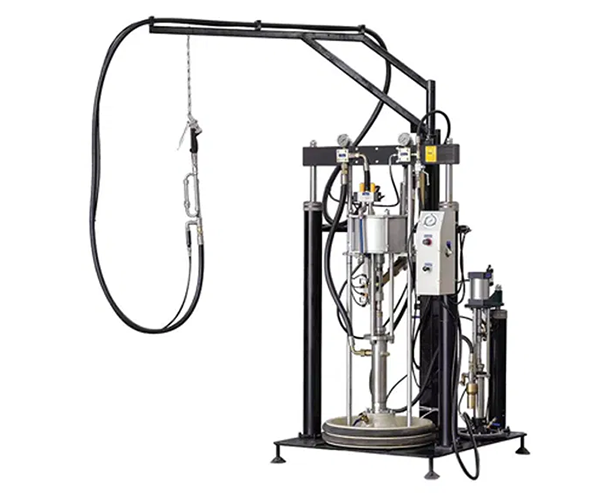
two-component sealant sealing machine is a two-component sealing machine produced with the latest domestic technology. It is suitable for sealing and bonding insulating glass, curtain wall glass, and mechanical manufacturing. The A-component sealant pump and the B-component sealant pump adopt hydraulic systems, and the pneumatic drive system is sensitive and reliable in commutation, and its convenient and unique ratio adjustment mechanism guarantees to limit the nearly stringent ratio requirements of the two-component sealant, continuous and uniform sealant output, good sealant coating effect, and high production efficiency.
Operation of a two-component sealant sealing machine
1. Connect the air source
Turn on the source, adjust the pressure-reducing valve to 0.4Mpa~0.6Mpa, and check whether there is air leakage in the system. Then test run the following actions: (1) A pump lifts; (2) A pump inflates; (3) B pump lifts; (4) B pump inflates. Note: When the lifting cylinder is lifted, if the two cylinders are out of sync, please lower it to the origin and then operate again.
2. Place the A and B component glue barrels in place and align them with the axes of the A and B glue pumps.
Take component A as an example:
1) Operate the manual rotary valve to lift pump A to high. During the lifting process, observe whether each pipeline is stretched too tight.
2) Place the glue bucket under the A-pump glue tray, open the glue bucket and the two-component glue machine accessories, turn the plastic bag out of the bucket, and take out the plastic sheet on the glue surface.
3) Slowly lower the pressure plate of pump A. When the pressure plate is put into the bucket, align it with the mouth of the bucket, and open the exhaust port of the pressure plate until the pressure plate touches the rubber surface. When all the gas in the pressure plate is exhausted and a small amount of glue overflows from the exhaust port, the exhaust valve can be closed. (The lift switch remains depressed)
4) Start the machine and try sealing: Turn on the air source switch of the main pump and press the glue gun switch until the air in pump A is exhausted and the glue at the muzzle is continuous.
Use the same method to operate pump B.
3. Sealant sealing operation
1) Loosen the locking screw of the proportional pump on the proportional lever and adjust the inside and outside of the proportional pump to the required ratio. Only when the ratio of glue A and glue B reaches the normal value can the following operations be performed?
2) Set the selection knob to A and B pumps, align the outlet of the glue gun with the middle seam of the two pieces of glass, turn on the glue gun switch, and move the glue gun smoothly at an appropriate speed to fill the glass tank with the two-component glue. good. Close the glue gun when the gluing is complete.
4. Replace the rubber bucket
1) When the glue in the glue bucket is used up, switches A and B should be turned off immediately to stop gluing.
2) Turn on the A (or B) glue pump inflation switch, select the A (or B) glue pump lifting mechanism to the ascending position, and move the knob to slowly lift the pressure plate. At this time, attention should be paid: try not to leave the glue barrel from the chassis until the pressure plate is completely separated from the glue bucket, and turn off the inflation switch of the A (or B) glue pump.
3) Remove the empty bucket, place the new glue bucket in the working position, and repeat operations 3 and 4.
Advantages & Features
The structural principle of the manual two-component sealant sealing machine
The two-component sealant sealing applicator is composed of A and B glue pumps, a pneumatic system, a lifting mechanism, a frame, etc. They are introduced as follows:
1. Sealant pump:
(1) Components A and B are each equipped with a sealant pump. Driven by their respective pneumatic motors, they make reciprocating motions to suck in and press out the sealing. Sealant pumps A and B are fixed together with the sealant plate respectively, and then connected to the frame to form their systems.
(2) The ratio of components A and B is adjusted through the proportional lever: when adjusted inward, the sealant output of B decreases; when adjusted outward, the sealant output of B increases. By adjusting the proportional lever, the sealant output of B sealant is controlled, thereby controlling the ratio of A and B sealant.
(3) Sealant output: controlled by the air source processor, adjust counterclockwise to increase the sealant output, and adjust clockwise to decrease the sealant output. (This refers to the total sealant output) This sealant pump adjusts the proportion of sealant A and B through a proportional lever. It has the characteristics of flexible operation, stable performance, and a large adjustment range.
2. Lifting mechanism:
Component A and B sealing pumps are each equipped with a set of pneumatic lifting mechanisms. The lifting mechanisms are composed of two parallel cylinders and are fixedly connected to their respective pump bodies through cross beams. One of its purposes is to apply the force of the two cylinders to the rubber surface through the pressure plate. The pressure is adjusted by the pressure regulating valve, generally around 0.3MPa;
Second, when the sealant barrel needs to be replaced, the cylinder can lift the pressure plate. Leave the sealant bucket to replace it with a new one.
Reviews
There are no reviews yet.