
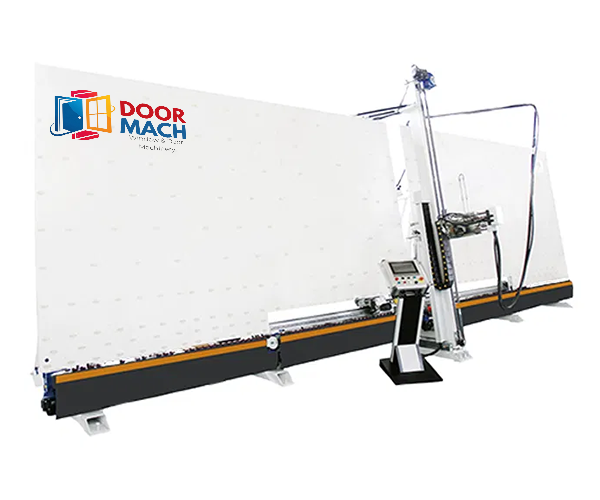
Description
- Equipped with a high-resolution precision photoelectric switch sensor that can detect glass thickness and sealing depth; the glass coating width can be automatically adjusted according to the input parameters. It is equipped with a Siemens PLC control system to realize automated transmission through servo motors and high-precision racks to ensure improvement in the glue coating accuracy of the equipment.
- It is equipped with an automatic glue replenishing function and adopts a unique pressure plate dual-channel sealing gasket structure to supply glue hydraulically to make up for the problem of glue overflow in the two-component glue barrel. Through the pressure control of the hydraulic station, the hydraulic station can meet the quantitative supply of oil to the driving cylinder, thereby controlling the quantitative supply of white glue A component, and then adjusting the proportion of B component glue through mechanical linkage to ensure a quantitative supply of black glue. ; It can automatically adjust the amount of glue output, greatly improving the sealing efficiency and saving the amount of sealant.
- The glue head adopts a new front glue head and has a special floating structure to ensure that the glue head does not damage the glass while meeting the requirements of a close fit with the glass. It can also adapt to the insulating glass within a certain range. Misalignment error; equipped with a glass pressing device to ensure safer movement of glass during transmission and gluing.
- The three-layer insulating glass can be sealed with glue. When sealing three-layer glass, first apply glue to the insulating glass of the first cavity. After the sealing process of the first cavity is completed, the glue head will automatically adjust the angle and then apply glue to the second cavity. The insulating glass is coated with glue.
- The V-belt adjustment structure can adjust the V-belt according to the thickness of different glass; it adopts a transmission method that combines high-quality and precise multi-row roller chains and V-belts. The rollers are in contact with the processed surface of the beam, so the friction is small and the transmission is smooth. High power; the glued glass runs smoothly, ensuring a good glue coating effect.
- Equipped with a rubber head pressing device, the pressure of the mobile cylinder of the rubber head can be adjusted through a precision electrical proportional valve to achieve compression of the rubber head, so that the rubber head adheres to the glass more smoothly.
- Equipped with a glue head centering structure, the glue head can be adjusted according to different thicknesses of glass. No matter how thick the insulating glass needs to be sealed, the glue nozzle can always be aligned with the center of the cavity of the insulating glass, resulting in a better glue effect.
- Equipped with a cleaning function, when the sealing equipment is not used for a long time, the glue supply pipeline needs to be cleaned (glue flushing) to prevent the glue supply pipeline from being solidified. When the cleaning function is performed, the mixed glue in the mixer pipe will be discharged, which can better protect the pipeline and prevent the rubber pipe from solidifying.
- When sealing the four corners of the insulating glass, the micro-glue filling function is optional to ensure the quality of the glue at the corners; the sealing effect can ensure that the edges of the insulating glass are full and air-free, the corners are full, and the four sides of the insulating glass are smooth and The sealant surface is smooth and even, no need for secondary corner trimming.
- Equipped with a “connection” function to the insulating glass production line, the sealing line also has the functions of unilateral gluing, alarm prompts, automatic hazard determination, and equipment locking.
- Servo motors, PLC controllers, low-voltage electrical appliances, sensors, and photoelectric switches are all from well-known foreign brands to ensure safe and reliable operation of the equipment and long service life; the human-machine operation interface is friendly and simple, making it more convenient for users to operate.
Advantages & Features
-
Japan Yaskawa servo system control, full automatic nd high-efficiency sealing machine
-
4 sections, can storage glass
-
Adopt timing belt, smooth transfer and accurate position
-
Automatically repair glass corners with scraper and roller
-
Automatically measure the glass size and the glass sealing depth (30mm)
-
Every auto-function is with manual operation
-
Can coat special type of double glass
-
Shape glass with optional edges, step glass, triple glass (Optional)
-
One set of booster pump controls two groups of sealants (Optional)
-
Can use silicone, polysulfide and silicone structural sealants
-
Glue head is in the front of the machine, whih is easy for coating step glass
-
Can be connected with insulating glass processing line
-
With code scanning function (Optional)
he Smooth Sealing Surface
The High-precision Servo Control System
The Glass Coating
Sealant Pump A and Sealant Pump B
Main Technical Parameter
| Item. | Spec. |
| Max. glass processing size | 2500*4500mm |
| Min. glass processing size | 400*280mm |
| Glass thickness | 3-15mm |
| Diameter of grinding wheel | 200mm |
| Conveyor height | 500mm |
| Edge deleting width | 10-50mm |
| Transmission speed | 29m/min |
| Edge deleting speed | 2-29m/min |
| Abrasive wheel width | 10/12/15mm |
| Grinding wheel speed | 0~3000r/min |
| Total air consumption | 100L/ min |
| Air pressure | ≥0.8MPa |
| Total power | 3P 380V 50Hz 3.35Kw |
| Dimension | 9700mm*2500mm*3400mm |
| Total weight | 3700Kgs |
The System Structure and Hardware Selection
The system is mainly composed of mechanical and electrical parts. The newly-added tray and Y-axis guide rail in the mechanical part are newly-added structures. As shown in Figure 1.
1. Support table
2. Guide support beam
3. Tray
4. Glue gun fixing column
5. X-axis guide rail
6. Y-axis guide rail
The electrical system includes the upper computer control part and the lower computer. The upper computer completes the real-time display and control of the glue application process information. The lower computer PLC accepts the signal from the field sensor, executes the program to process the data, and drives the execution unit. The selection of the main components is shown in Table 1.
Table 1 The selection of the main components from LIJIANG Glass Automatic Insulating Glass Sealing Robot
| NAME | ORIGIN | BRAND |
| Servo motor | Taiwan | TAIDA |
| PLC | Taiwan | TAIDA |
| Pneumatic component | Taiwan | AAIRTAC |
| Low pressure electricity | Germany | SIEMENS |
| Circuit breaker | Germany | SIEMENS |
| Sensor switch | Korea | AUTONICS |
| Approach switch | Korea | AUTONICS |
| Limit switch | Taiwan | TEND |
| Connector | Germany | SIEMENS |
| Frequency converter | France | SCHNEIDER |
| Main Button | France | SCHNEIDER |
| Intermediate relay | Japan | OMRON |
The Servo Unit Parameter Setting
The normal operation of the servo unit requires the relevant parameters to be set as follows:
(1) Setting of speed control mode
When the glue output of the glue dispenser is constant, the glue can be applied even when the servo motor speed is stable, so set the servo unit to speed control mode, that is, Pn000.1=0. Use the proportional relationship between input voltage and speed to set the speed input command. When the set speed command input is +9V, the forward speed of the motor is 1500r/min, and when the input is +3V, the forward speed of the motor is 500r/min. Pn300=900, the “rEF_0” attribute of Fn009 is set to “donE”.
(2) Setting of start and stop time
To get smoother constant acceleration and deceleration, it is necessary to set its soft-start function. as shown in picture 2. In the figure, Pn305 is the time required for the motor to reach the maximum speed from the stopped state, Pn306 is the time for the motor to reach the maximum speed from the maximum speed, ta is the actual acceleration, TB is the actual deceleration, nN is the maximum speed or rated speed, and n is the actual Operating speed.
The voltage U and speed n of the PLC analog output signal meet:
According to experience, adjust the acceleration and deceleration time setting ta=tb=100ms, nN=1500r/min, use the above formula to set Pn305 and Pn306.
(3) Setting of basic operating functions
Combined with the control requirements, the control of the servo unit needs to meet the servo ON always effective, the forward and reverse control of the guiding support beam and the tray; over-travel protection; motor free-running stop and emergency stop. The parameters are set as:
Pn50A.1=0, Pn000.0=0, Pn50A.3=2, Pn50B.0=3, Pn001.1=2, Pn001.0=2.
The Software Development
(1) PLC software design
The PLC program adopts a modular design method and is completed with function blocks. FC1 is initialized, and the tray is reset through the magnetic sensor; FC2 collects information from the host computer and selects the operating speed of the servo motor according to the glass specifications determined by the host computer; the initial position of the FC3 glass is confirmed, and the optical fiber sensor detects whether to enter the automatic four sides Gluing process; FC4 four-side gluing function, the gluing process has 4 sequential states, state 1 is the X-axis, state 2 is Y axis, state 3 is X-axis and state 4 is Y-axis; FC5 Detect the arrival of the next glass. If it is detected within the set time, the specifications of the glass will be confirmed. If the next glass is not detected, the control process will be completed.
(2) MCGS configuration software design
The main screen of the host computer monitoring system includes four sub-screens: user login, manual/automatic control, communication test, history query, and printing. Before performing control or parameter setting, the communication connection between the PLC and the host computer needs to be tested. The start, manual, and automatic detection of all motors, as well as the detection of sensors, use the Light control to display the detection status, and the connection status is distinguished by color. After entering the manual/automatic control mode, first, select the glass specifications, determine the amount of glue and the motor running speed, and then enter the control mode. Each servo motor can realize forward and reverse manual/automatic, and there is an interlock between the two. In addition, the specifications, processing time, and servo alarm conditions of the coated glass are displayed, and historical data conditions can be inquired and printed.
Reviews
There are no reviews yet.